A sacred narrative spanning the cosmic, the historical and the contemporary — where mythology, geography and devotion meet at the foothills of the Jaintia range.
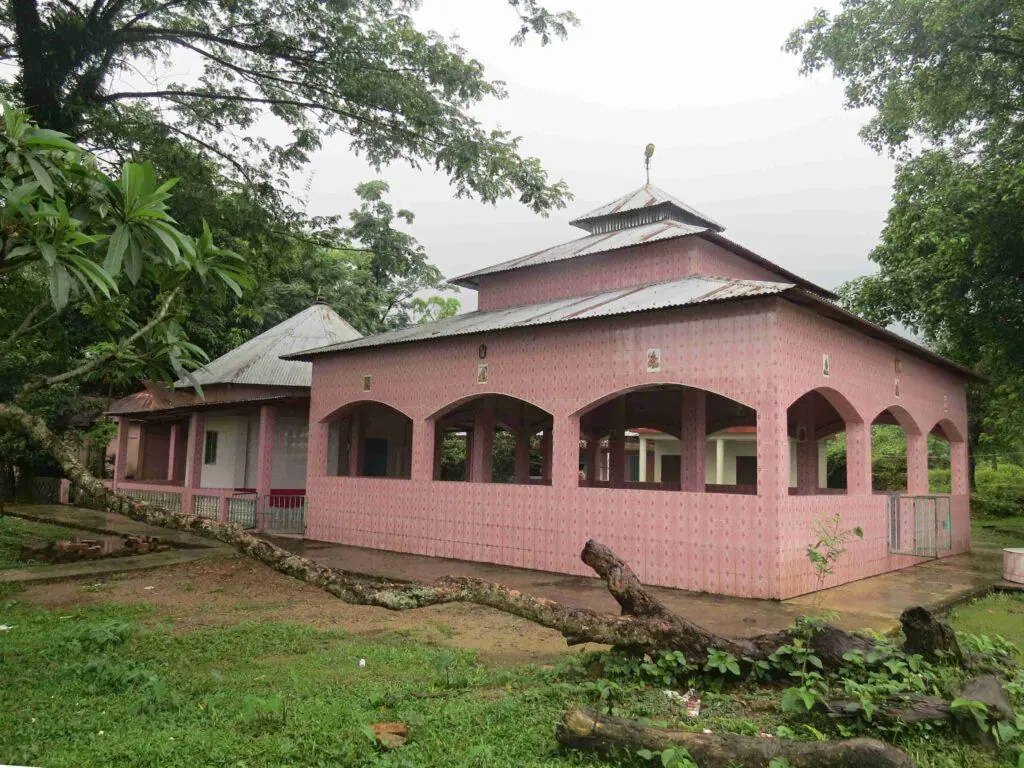
Jaintia Shaktipeeth is among the oldest and most spiritually charged shrines of the Bengal–Assam frontier. Located in Bourbhag village near Jaintiapur in the Sylhet District of Bangladesh, the temple sits at the foot of the Jaintia Hills — a sacred zone described in scripture and sustained in living memory.
Its history is interwoven with three distinct currents: the Puranic tradition that consecrates it as one of the 51 Peethas; the Jaintia kingdom's patronage, which preserved it across the medieval era; and the contemporary devotional revival through which a new generation of pilgrims, scholars and cultural stewards have re-discovered its significance.
Despite the political reorganisations of the 20th century, Jaintia has remained a continuous site of worship — a quiet but unbreakable thread of civilisational continuity between modern India and Bangladesh.
Where Sati's left thigh is said to have fallen — sanctifying this earth as an eternal seat of feminine power.
According to the Devi Bhagavata Purana, the cosmic story of the Shakti Peethas begins with the great sacrifice of Sati — the consort of Lord Shiva — who immolated herself in protest against her father Daksha's insult to her husband. Overcome by grief, Shiva carried Sati's body across the cosmos in his Tandava — the dance of dissolution.
To restore cosmic order, Vishnu's Sudarshan Chakra dismembered her divine form, and the parts of her body fell to earth in fifty-one consecrated locations across the subcontinent. Each spot became a Shakti Peetha — a place where the Goddess remains permanently present.
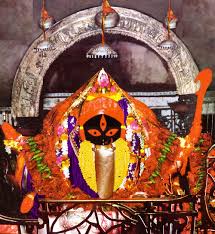
At Jaintia, it is believed that the left thigh of Sati descended. The thigh — the seat of strength, mobility, foundation and stability — defines the spiritual personality of this Peetha. Devotees travel here for vows that require courage, fortitude and forward movement in life.
The Goddess at Jaintia is therefore worshipped as the Victorious Mother — Devi Jayanti — and her sanctified consort here, in his sacred local form, is Lord Kramadishwar, the rhythmic Lord whose name itself signals the unfolding order of the universe.
The Victorious Mother. Worshipped as the embodiment of triumph over inner and outer adversity, courage, justice, and fortitude. Her presence here is invoked particularly during Navaratri and Durga Puja, when the shrine becomes a centre of pan-regional devotion.
The local Bhairava form — the Lord of rhythmic order. Devotees seek his blessings for the unfolding of life's stages with discipline, balance and momentum. His presence completes the consecrated pairing of Shakti and Shiva at Jaintia.
Mentioned in the Tantrachudamani, Pithanirnaya and the Devi Bhagavata Purana as one of the original Shakti Peethas — a recognition that places it firmly in the canonical Shakta map of the subcontinent.
The shrine has been part of an unbroken Tantrik and Shakta lineage practiced in eastern Bengal — preserving rituals, mantras and ritual geometries that trace their origins to ancient sacred manuals.
Jaintia is one of the principal stops on the cross-border 51 Shakti Peetha pilgrimage circuit — connecting devotees from India, Bangladesh, Nepal, Sri Lanka and the global diaspora.
The temple's setting is itself a sermon. The Jaintia Hills rise gently to the north and east of Sylhet — a green wall of forest and stone that has long served as a natural sanctuary for sages, saints and meditative orders.
The river-fed lowlands of Sylhet meet the rugged escarpment of Meghalaya at this very point. It is a borderland in the most literal and the most sacred sense — between plain and mountain, between secular and sacred, between the two modern nations that once formed a single civilisational landscape.
Few shrines in South Asia possess such a powerful natural setting. The hills, the rivers, the monsoon-fed forests, and the silent stone of the temple form a single, inseparable spiritual environment.
Sylhet has been a meeting ground of Bengali, Assamese and Khasi cultural currents for over a millennium. It carries an unusually rich legacy of saints, scholars and Tantric masters, many of whom were patrons or pilgrims of Jaintia Shaktipeeth.
Once the capital of the Jaintia Kingdom, Jaintiapur retains the ruins, megaliths and ritual sites of a sovereign Hindu polity that ruled across Sylhet and the western Khasi Hills until the 19th century. Jaintia was a state-sponsored shrine in this era.
The temple village of Bourbhag is small, quiet and devotional in character. The geography is intimate — paddy fields, palm groves, distant ranges — making it an immersive setting for pilgrims who seek not only darshan but contemplation.
Jaintia Shaktipeeth continues to attract devotees, scholars, NRIs, diplomats and heritage enthusiasts — anyone who recognises sacred geography as a powerful form of civilisational continuity.
Daily rituals, seasonal pujas and Tantric observances remain in continuous practice — sustained by traditional priestly families and devoted lay communities.
Researchers in Sanskrit, Tantric studies, and South Asian religious geography frequently consult the site for its cultural and architectural value.
As a borderland shrine, Jaintia serves as an organic platform for Indo-Bangladesh cultural cooperation — a soft-power asset of immense subtle weight.
A small, focused leadership council of nation-builders, cultural strategists and Track-II diplomats committed to elevating Jaintia as an internationally recognised sacred destination.
Founder, Torus Group · Architect, SAKSHAM Mission · Co-Founder, Bangladesh Cultural Heritage Trust.
View detailed profileRegional Youth Engagement & Cultural Affairs (BIMSTEC) · Civilisational Dialogue · Cultural Geopolitics · Indo–BIMSTEC Regional Integration.
View detailed profile